feedspot.com/wp-content/uploads/2017/11/woodturning_216px.png

Thursday, 17 February 2011

A bit of glamour

I thought I would add a bit of glamour to my Blog.
These are a few pics of my Model grandaughter Ali.
Ali models and sells Goth clothing.


Wednesday, 16 February 2011

VivaMac DB 1000

Went to see my mate Richard Fairbrother today and had a go on his VivaMac 1000 lathe.
A nice solid lathe but I would not swap it for my Nova.
I roughed out some wet Cherry and Sycamore bowls but found it slow compared with the Nova.
The difference seems to be that the WivaMac takes time to wind up to speed and takes quite a lot of time to slow down.
Another thing it is not very quick to swivel the head .
I don't think it is as powerful as The Nova.
Taking big cuts it seemed that I could stall it if I was not careful.
With the Nova you would have to be quite brutal to stall it.
                                                 
                                                           Click on pic to make it bigger

Tuesday, 15 February 2011

Display

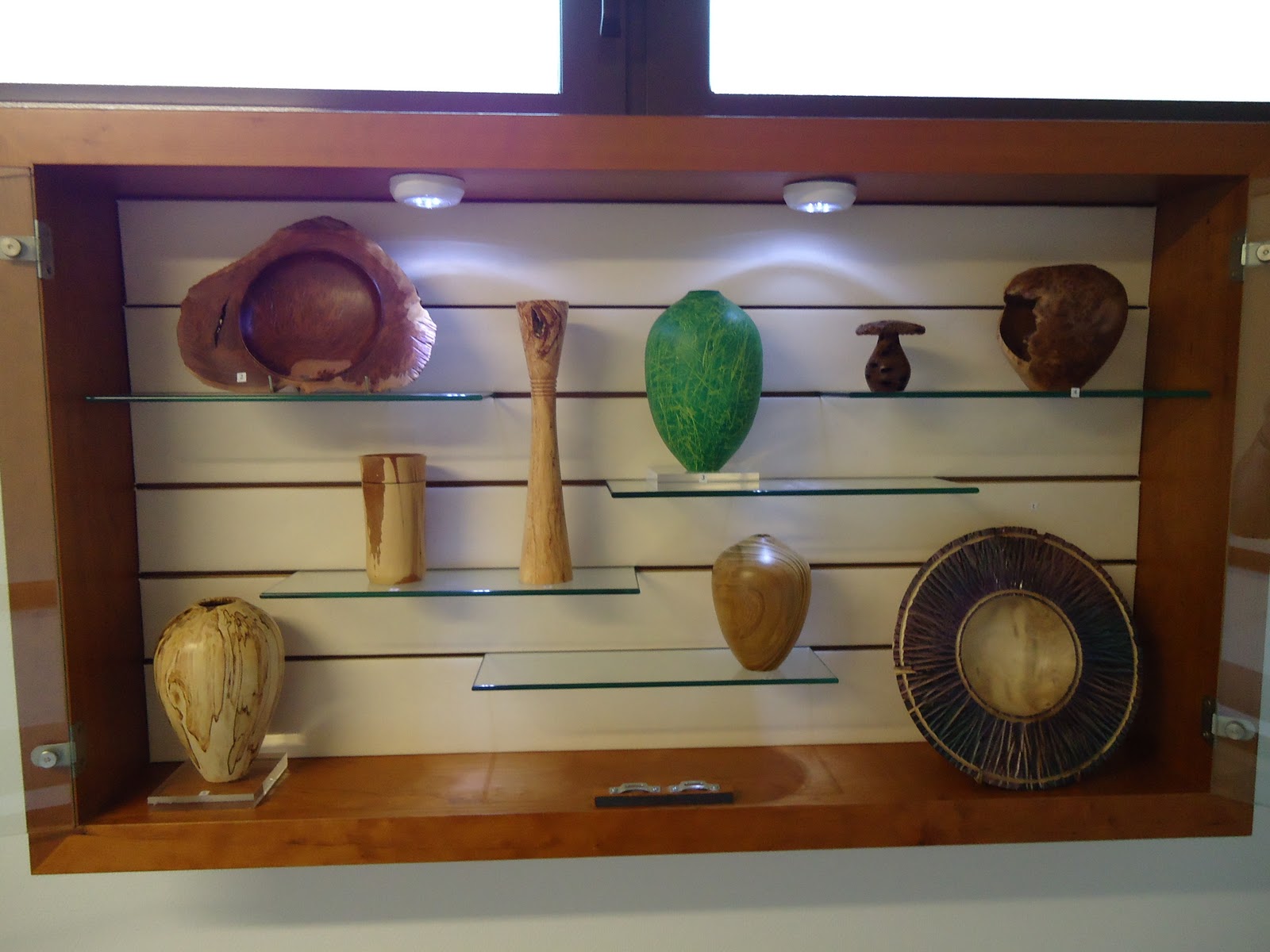
This is the display of some of my work in The Musgrove Park Hospital Taunton Somerset.
A bit difficult to display in because the cabinets are very narrow .
I am quite pleased how they turned out.
                                                        Click on pics to make bigger


Saturday, 12 February 2011

Making an Indexing system.

A lot of small lathes and even some bigger lathes do not have any indexing system.
This post is going to show you how I have made a simple and cheap indexing system.
This is not difficult and took me about an hour and a half.
They only thing I will say is you have to take the time and effort to do it accurately.If not you might as well not bother as an indexing system that is not precise is an absolute waste of time.
My first lathe never had an indexing system so I thought i would make my own but it was not as simple as I thought.
I tried using a protractor dividers set squares and all sorts but nothing was accurate enough.
This is when I thought of the system I am going to show you.

The most important thing to use is a 24 tooth circular saw blade.
24 tooth is perfect as it divisible and gives you a wide range of devisions.
The blade must be in good condition as accuracy is paramount.

The system is made of polycarb as this is strong and easy to drill and cut.
First secure the blade to the polycarb with double sided tape to stop any movement.
Then lay a steel ruler across the blade from the point of one tooth to the corresponding tooth on the other side.
You have to be absolutely precise with this.
                                                        Click on pics to make them bigger
Now scribe both sides with a craft knife .A pencil is not good enough for this.

Do this all the way around and then remove the blade and join all the lines up.
If you have done this properly all the lines will cross the dead centre as below.

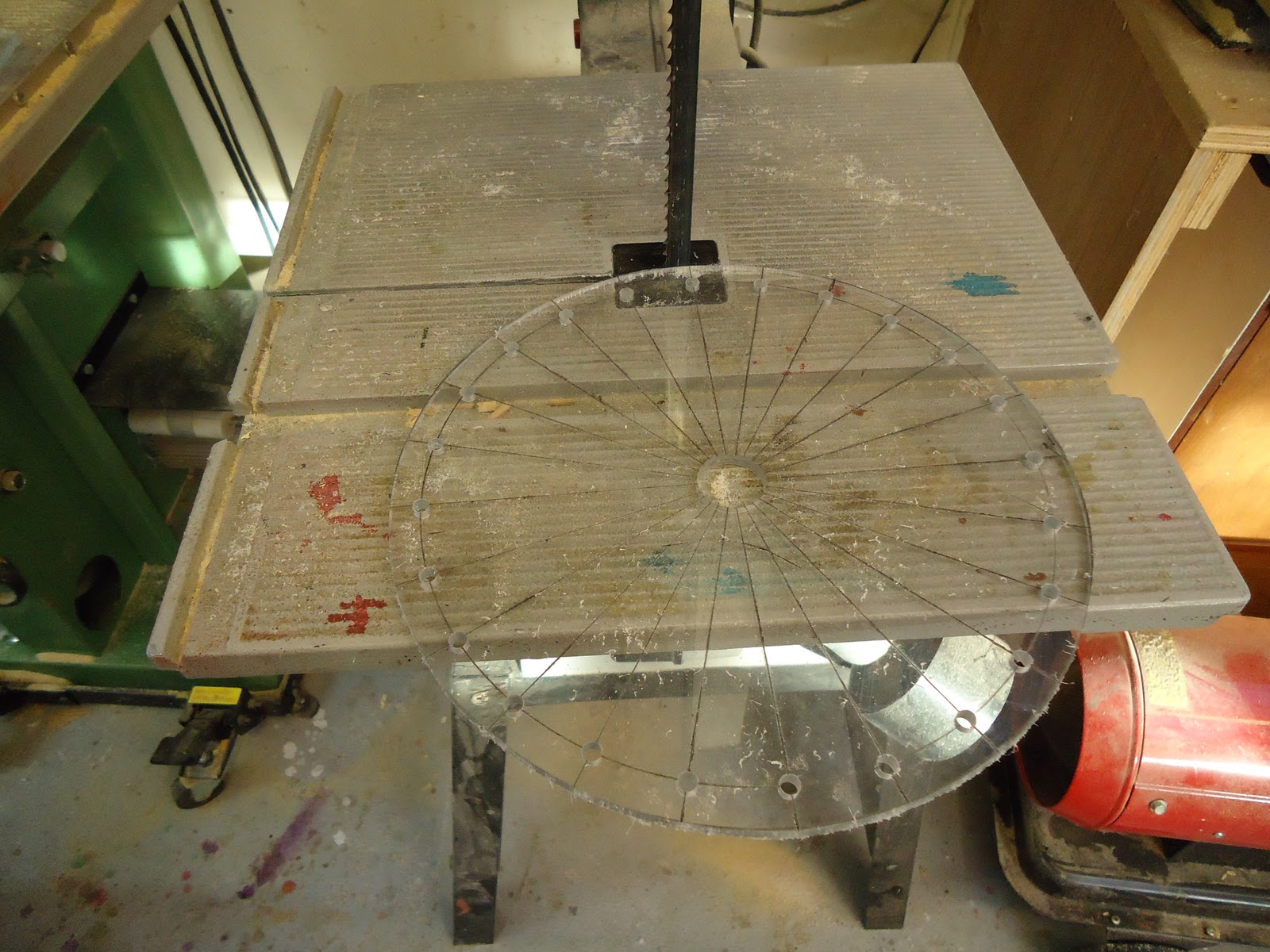
Now scribe two circles the outer one is the diameter of the finished disk and the inner where you will drill your indexing holes.

Here I have rubbed black wax over the disk to make all the lines show up better.
Next check the spindle size so that you will drill the right sized hole .You only get one go at this if you get it wrong it will be very hard to put right.
The centre is now drilled out with a forsener bit.

That done we are ready to drill the indexing holes.
I have used a pointed wood bit as it is easier to get precise positioning.
I rest the point on the cross and then start the dill.I do this for every hole stopping between holes to re position to avoid mistakes.
As you can see from the next pic every hole is exactly where it should be.

Now we can cut the disk to the required size on the bandsaw and tidy up the edge on the sanding disk.

The disk is fitted on the spindle and the chuck holds it in place as below.
All that is left is to make some sort of lever to locate in the indexing holes.
This is a simple polycarb strip with a bolt glued in it and fixed to the lathe bed.

As you can see from this last pic the indexing arm is under tension so that when located in the disk it is firm.

I hope i have explained this well but if there is something you are not sure of please contact me.

Friday, 11 February 2011

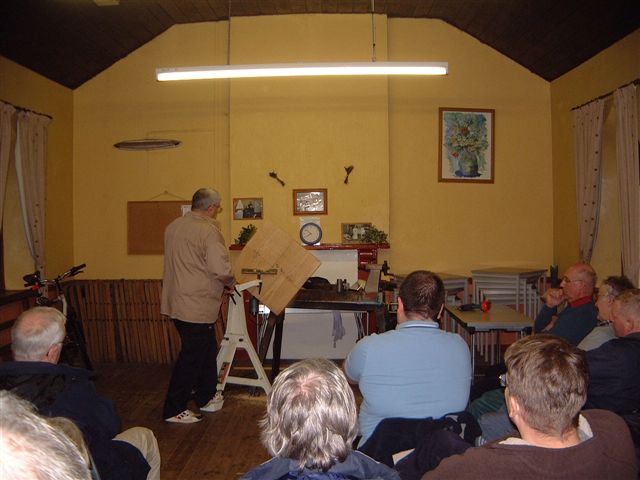
Pembroke club demo

I have just returned from a few days away in Pembroke south Wales.
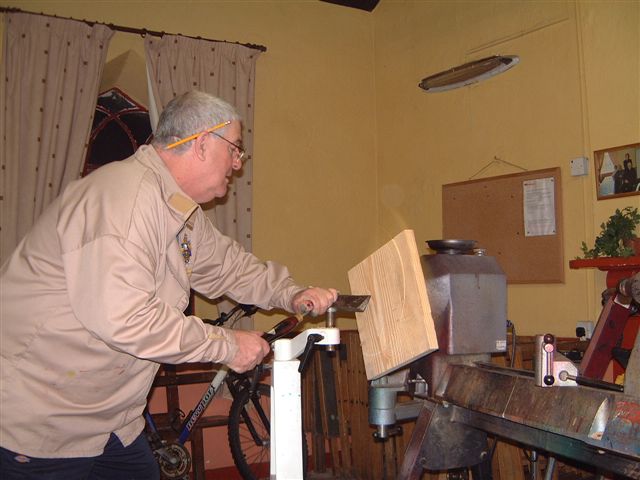
While i was there i carried out a demo on making Wall Plaques for the Pembroke Woodturning Club who kindly made me a life member last February when i did a demo for them.
A bit of lighthearted banter,some serious turning and colouring went down well with the 25 members present.
Here are a few pics from the demo.
The pics are in no particular order they are as they came to me from one of the club members John Blake.


Wednesday, 2 February 2011

Oak Conservatory sculpture.

The inspiration for this piece was taken from this months Woodturning mag.
Mark Sanger has shown the way to make this sort of sculpture in great detail so i will not be showing it here.
                                             Click on pics to make them bigger.
                                                      

Sunday, 30 January 2011

Wall plaque or wall plaques

We start of with two boards of Yellow Pine one foot wide and two feet long.

                                                       Click on pics to make them bigger.
Now we mark the center and fix a 6" face plate on and for added safety i have screwed straps to either side.

Because this is a square it is quite well balanced and i turn it at 350 RPM.

Starting from the center I turn  circles at various radius's It is not necessary to make space each circle accurately.
This is done with the only tool I will use for this project a 3/8" spindle gouge.
As you can see I have turned the Headstock to the side and use the Jet free standing tool rest.
The important thing when cutting the circles is to make sure you are cutting not scraping.
If you scrape you will get tear out on the cross overs.
The handle of the gouge is kept low and the cut is at two O clock.

Note the fine shavings this is because the wood is being cut not scraped.
Now we have the first set of circles and as you can see they are spaced wider as i move out.
Having completed as many of the circles as I require the piece is removed from the lathe ready for the next set up.
The two boards are now swapped from side to side ready to commence the next set of circles.
As you can see we now have half circles top and bottom.
Now we can make the next set of circles as the following pic shows.

The piece is removed again and the two boards are sawn in half.
We now have four one foot by one foot squares.
These are placed together and a 6" faceplate fixed.
The faceplate is positioned so that there are two screws in the corner of each square,
For added safety I have attached two straps plus two short ones to keep it all together.
I am keeping to the same lathe speed 350 RPM.

This is now re mounted and the last set of circles turned as the following pic shows.
That is all the turning finished and the piece is ready for coloring.
Before i start scorching and coloring I clean up below the lathe to avoid the risk of fire.
That done and the lathe turned off i scorch the whole piece,
This quite a light scorch and very random.
With the piece now completely scorched it is time to apply color.
For my colors I am using Chestnut Spirit stains applied with a diffuser.
This is a method I learned from Nick Agar.
For them that are not familiar with a diffuser it is two pipes set at a 90% angle to each other and by blowing in one with the other in the spirit stain you create a spray.
These can usually be bought in good Art shops.

The first color is Red and applied over the whole piece.I am not worried if it is not uniform as this adds to the final finish.

On top of the Red I have applied Blue then Purple.
Now Yellow is sprayed over the complete piece this softens the colors and makes them blend together.
Three coats of Chestnut Acrylic satin lacquer is applied to the whole piece.
After the Lacquer has dried i apply some more yellow spirit stain.
I put the last coat of spirit stain on top of the lacquer so that it shows up better as it is not soaked into the other colors,
Another three coats of lacquerer has been applied and they are removed from the lathe.

We now have four different but matching wall plaques .
They can now be hung as a set or as you will see in the next pics one large wall plaque.
These are going to be put in a frame which will be made by my mate Richard Fairbrother who is a furniture maker.
We will probably make the frame from MDF and leave it unpainted.
The next pic gives you an idea of what they will look like framed.
Richard will make the frame in the next couple of days so you will have to keep looking to see how it turns out. http://www.richardfairbrother.com/

To be continued